
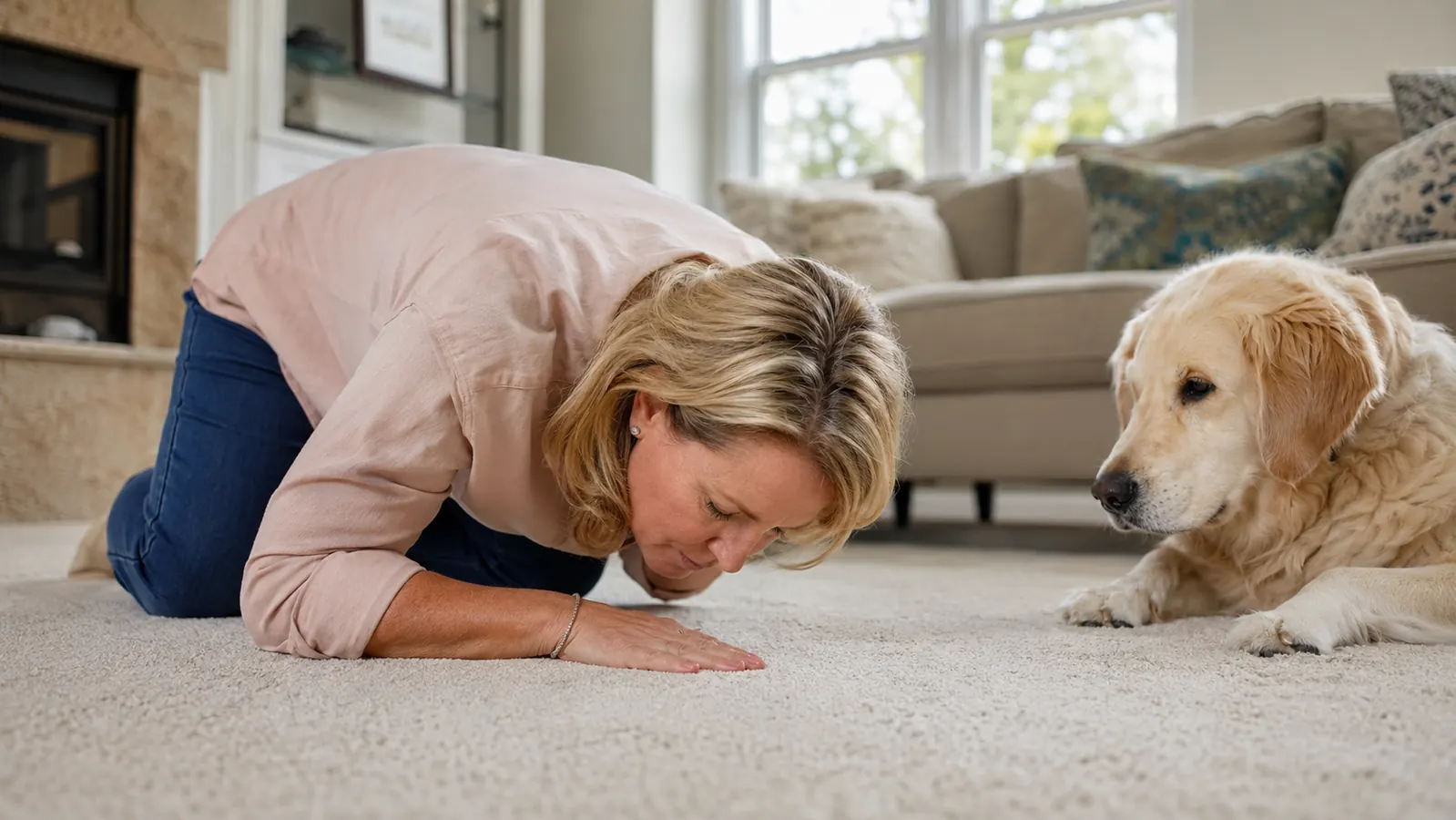
I have been doing this for over 20 years. Fostering and rescuing dogs and cats means my house has seen every kind of accident, on every kind of surface, at every hour of the day. And the single most common question I hear from new foster families or friends adopting their first pet is some version of this: "I cleaned it but I can still smell it. Why?" The answer matters, because if you do not understand it, you will keep cleaning the wrong way and the smell will keep coming back.
Pet urine is not just water with a color. It contains urea, uric acid, urochrome, bacteria, and ammonia compounds. Most household cleaners, including popular ones that foam and smell like lavender, tackle the surface layer fine. But uric acid crystals bind tightly to carpet fibers and the pad beneath, and they do not dissolve with soap, steam, or vinegar. What does break them down is an enzyme cleaner, a specific class of protein-eating enzymes packaged as a pet stain and odor remover. That is the only real fix, and everything else is just buying yourself a few days before the smell comes back, especially when the weather gets warm or the carpet gets damp. This guide walks through the full process, wet stain to dried-in spot to the stubborn corner that your dog has been treating as a dedicated bathroom for six months.
If your carpet still smells after cleaning, this is probably why it is not working
Rocco and Roxie Extreme Stain and Odor Eliminator uses professional-strength enzymes that break down uric acid at the molecular level. Over 126,000 Amazon reviews. Works on fresh accidents and dried, set-in stains.
Amazon Check Today's Price on Amazon →Step 1: Act Fast on Fresh Stains and Blot, Do Not Rub
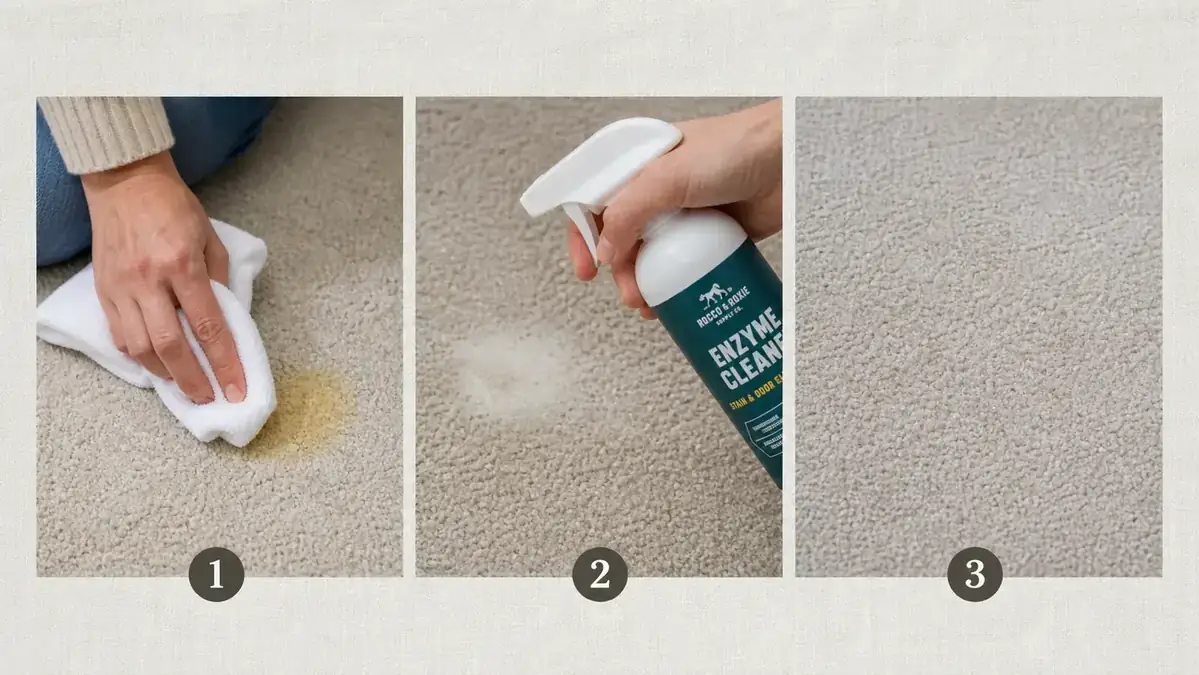
If the accident just happened, you have a window. The goal in the first two minutes is to pull as much urine out of the carpet as possible before it soaks into the padding below. Grab a thick stack of paper towels or a clean white cloth, press it firmly onto the spot, and hold steady pressure for about 30 seconds. Lift. Repeat with a fresh section of towel until you are not pulling any more color out. Do not scrub, wipe, or grind the towel in circles. Rubbing spreads the urine outward and pushes it deeper into the fiber, making the stain bigger and the cleaning job harder.
If you have a wet-dry shop vac, even better. Set it to wet mode and vacuum the spot for 30 to 60 seconds before you do anything else. This pulls urine up from the pad, which is the layer that holds odor longest. One thing I learned the hard way with my first foster dog, a 7-year-old beagle mix named Biscuit, is that the carpet surface can look and smell clean while the pad beneath is still saturated. That is why the smell comes back two weeks later. Removing liquid from the pad first is worth the extra step.
Rinse the spot lightly with cool water, not hot. Heat sets protein stains just like it sets food on pans. A small pour of cool water followed by another round of blotting helps dilute what is left before the enzyme treatment goes on.
Step 2: Apply Enzyme Cleaner Generously and Let It Sit Long Enough to Work
This step is where most people go wrong, and they go wrong in two ways. First, they use too little product. Enzyme cleaners need to penetrate to the same depth the urine reached. If the accident soaked into the pad, a light surface spray will not get there. The rule of thumb I follow is to apply enough enzyme cleaner to visibly saturate the area, roughly the same volume of liquid as what came out of the pet. For a standard dog accident on medium-pile carpet, that usually means a full 5 to 8 seconds of steady spraying concentrated on the center and feathering outward about an inch past the visible stain edge.
Second, they do not wait. Enzyme cleaners are biological, not chemical. The enzymes need time to find and break down the uric acid crystals. The label on Rocco and Roxie Extreme says to let it sit for 10 minutes minimum. I let it sit for at least 20 on fresh stains and a full hour on anything dried or old. Cover the treated spot loosely with a damp cloth to keep it from drying out too fast, especially in low-humidity rooms. If the cleaner dries before the enzymes finish working, you stop the reaction mid-process.
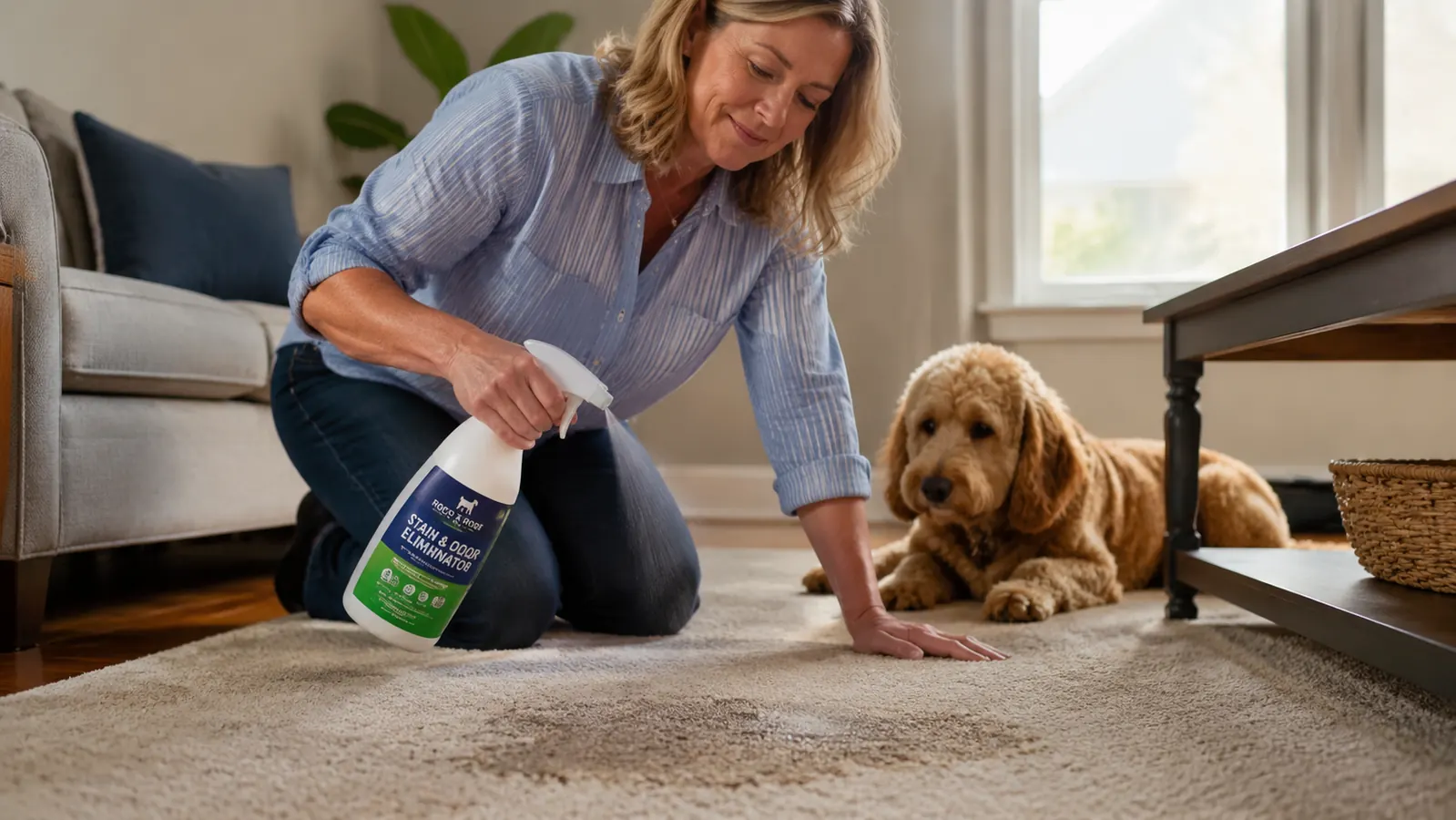
After the dwell time, blot the area dry again with fresh towels. You do not need to rinse the enzyme cleaner out. The enzymes continue to work as long as there is moisture present, so leaving a slight residue is fine and actually helps with any uric acid you did not fully reach on the first pass.
Step 3: Find and Treat Dried or Hidden Stains With a UV Blacklight
Old stains are not always visible under normal light, especially on patterned or medium-tone carpet. Urine fluoresces under ultraviolet light, so a UV blacklight flashlight (they are inexpensive on Amazon) turns a guessing game into a precise map. Take the flashlight into the room after dark, sweep it slowly across the floor, and you will see every spot your pet has used, including ones that happened months ago. Mark each glowing spot with a small piece of painter's tape before you turn the lights back on so you know exactly where to treat.
For dried stains, the enzyme application process is the same but requires more patience. Dried uric acid crystals are bonded more tightly to the fiber. I rehydrate the spot first with a small splash of cool water, let it soak in for two minutes, and then apply the enzyme cleaner as described in Step 2. On a stain that has been sitting for more than two weeks, I do a second application the following day. One treatment is often enough for fresh stains. Dried, set-in stains usually need two.
One thing worth knowing: if you previously treated the spot with a bleach-based cleaner or an enzymatic formula that was too diluted to work, there may be residue that interferes with the current enzyme cleaner. A quick rinse with plain water and a thorough blot before applying fresh product helps clear that out.
Step 4: Handle Repeat-Soaker Spots Where the Pad Is Saturated
The hardest spots to fix are the ones a pet returns to repeatedly, often because they can still detect their own scent there even after you have cleaned the surface. If a single area has been hit more than five or six times, the carpet pad underneath is likely saturated with uric acid from multiple accidents stacked on top of each other. In those cases, surface treatment alone, no matter how good the product, will not fully eliminate the odor because the source is below the carpet layer itself.
For these spots, peel back the carpet edge if you can reach it, or at minimum apply enzyme cleaner from above in large enough volume to soak all the way through to the pad, roughly two to three times the amount you would use for a regular single accident. You are trying to flood the pad the way the urine flooded it, so the enzymes can get to every layer. Let the dwell time extend to two or three hours, keeping the spot covered and damp. Then blot from above as much liquid as possible and allow it to air dry completely before walking on it or replacing furniture.
In rare cases where the pad damage is extreme, the most permanent fix is to cut out and replace that section of padding and treat the subfloor underneath with enzyme cleaner before relaying. That sounds dramatic, but if you have a corner that has been a repeat spot for years, the pad at that point is essentially a permanent odor source and no surface treatment will overcome it long term.
Step 5: Dry Thoroughly and Prevent Re-Marking
Drying the treated area completely is the final step most people rush, and it matters more than it might seem. Carpet that stays damp for more than a few hours can develop mildew, and a mildew smell layered over a treated urine stain is genuinely confusing because it can read as lingering urine odor even when the uric acid is gone. After blotting up as much moisture as you can manually, set up airflow. Point a box fan at the spot, open windows if the weather allows, or use a dehumidifier in the room. On thick-pile carpet or in humid climates, plan for 8 to 12 hours of drying time.
Once the spot is fully dry, check it with the UV light again. If it no longer fluoresces, or fluoresces only faintly, the treatment worked. If there is still a strong glow, run a second application of enzyme cleaner. Faint residual glow after two treatments usually means the odor is gone to human noses even if trace mineral deposits remain, and those traces do not smell.
To discourage your pet from returning to the treated spot, a spritz of citrus-scented deterrent spray once the area is dry can help. Pets tend to avoid citrus. But the most reliable deterrent is a thorough enzyme treatment, because if they can no longer smell their own scent there, the behavioral pull disappears on its own. This is why enzyme cleaners outperform odor neutralizers for multi-pet households: neutralizers mask the smell for you, but the pet's nose cuts right through them.
What Else Helps
A few things make a real difference in multi-pet homes. First, keep an enzyme cleaner stocked so you never run out right when you need it. Running to the store while a wet stain dries is losing the most important window. I keep a spare bottle under the bathroom sink at all times. Second, washable area rugs over high-traffic carpet spots give you an easier cleanup layer, especially in the spots your youngest or oldest pet tends to favor. Third, if you have a senior dog having accidents more frequently, it is worth a vet visit to rule out a UTI or kidney issue before you spend more time on carpet cleaning. Treating the surface while the root cause goes unchecked is a treadmill.
For hard floors under and around rugs, enzyme cleaner works the same way. Wood floors need a more careful application since you do not want to oversaturate the wood, but a light spray, 10-minute dwell, and thorough wipe is enough for most surface accidents. Grout lines in tile are another place urine hides and where enzyme cleaner is the only thing that works long term. The same rules apply: saturate, wait, blot dry.
One product that has worked consistently for me across all of this, fresh accidents and old stains and the stubborn repeat spots, is Rocco and Roxie Extreme. I have tried most of the well-known enzyme cleaners over 20 years, and the combination of enzyme concentration and the way it stays active under the carpet surface puts it a step ahead of lighter formulas. At over 126,000 Amazon reviews with a 4.4 average, it is clearly working for a lot of households beyond just mine. It is not magic, and the technique still has to be right. But with the right technique and the right product, most carpet odor problems, even old ones, are genuinely fixable.
Most carpet smells like it was cleaned. Enzyme cleaner makes it smell like there was never an accident in the first place. That is the difference.
Ready to actually fix the smell, not just cover it up?
Rocco and Roxie Extreme Stain and Odor Eliminator is the enzyme cleaner I keep stocked at all times. Works on fresh accidents, dried stains, and the stubborn spots that have been through five other products already. Check today's price on Amazon and read why 126,000 pet owners keep it in the house.
Amazon Check Today's Price on Amazon →