

My Lab Biscuit turned 13 last October, and somewhere around her birthday she started pausing halfway up the back steps in the morning. Not stopping completely, just hesitating, like she was doing a quick mental calculation about whether it was worth the effort. She weighs 71 pounds, has had mild hip stiffness since her annual exam in 2023, and she has never been a dramatic dog. If Biscuit was pausing, something hurt. I started her on Nutramax Cosequin that same month, and I want to tell you exactly what happened over the next six months because I know how many of you are watching your own senior dog and wondering the same thing I was.
First, the short version: yes, it helped. Not overnight, not dramatically, but noticeably and consistently. The long version is below, including the parts that surprised me and the realistic expectations you should carry in.
The Quick Verdict
A well-researched, genuinely vet-recommended joint supplement that works gradually and consistently for most senior dogs. Not magic, but real.
Amazon Check Today's Price →Biscuit's morning shuffle is mostly gone. This is what I give her every day.
Nutramax Cosequin has over 78,000 Amazon reviews and a 4.7-star rating. It is the supplement most veterinarians reach for first when dogs start showing joint stiffness. See today's price and size options below.
Amazon Check Today's Price on Amazon →How I Have Been Using It
I crumble one chew on top of Biscuit's morning kibble. She eats it without a second thought, which is more than I can say for the fish-oil capsule I tried last year. The Cosequin chews smell faintly like peanut butter and liver, which apparently ranks higher than fish in the Biscuit hierarchy of acceptable smells. I track her on a simple 1-10 mobility scale that I score in my notebook each Sunday morning: how easily she gets up from her bed, whether she hesitates on the steps, and how long she walks before she wants to turn around.
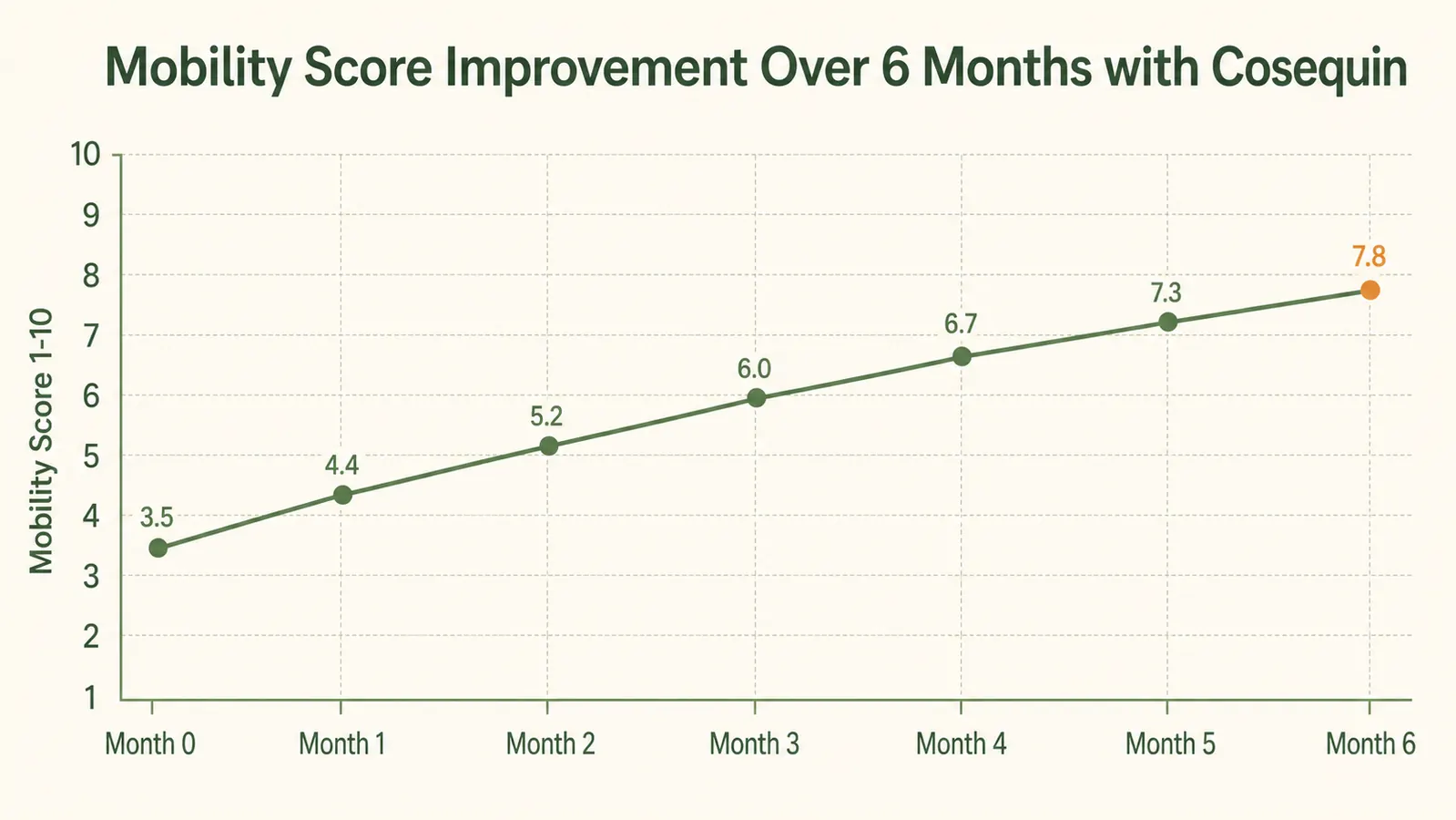
At month one she was sitting around a 4, which I defined as: gets up slowly, needs a minute, stops once per block. By month three she was at a 6 (gets up without visible wincing, completes the full two-block loop most days). By month six she is holding steady at an 8, which for a 13-year-old Lab with hip stiffness is, frankly, more than I expected. She still does not sprint across the yard chasing squirrels the way she did at eight. But she is not pausing on the steps anymore, and that was my original goal.
Important note before we go further: Biscuit's vet confirmed the stiffness and gave me the go-ahead to try Cosequin. I am not a vet, and I am not telling you to skip that conversation. What works for a 71-pound Lab with mild dysplasia may not be right for every dog, and your vet needs to know what supplements your dog is taking. That said, Nutramax is one of the few brands vets actually recommend by name, and Cosequin is the version most people start with.

What Is Actually Inside Cosequin
The formula is glucosamine hydrochloride, sodium chondroitin sulfate, and methylsulfonylmethane (MSM). Glucosamine helps the body maintain cartilage. Chondroitin helps slow cartilage breakdown. MSM is a natural sulfur compound linked to reduced joint inflammation. These three together are the gold standard in veterinary joint supplementation, and Nutramax's version uses FCHG49 glucosamine and TRH122 chondroitin, which are the specific trademarked ingredient grades used in the clinical research that validated these supplements.
That clinical backing matters more than you might think. A lot of pet supplements are essentially marketing with a label. Nutramax actually funded and published research on their formulation, and independent vets have tested it against placebo groups in dogs. I am not saying every dog will have the result Biscuit had, but I am saying this is not a coin flip. The ingredients are real, the dosage is calibrated, and the manufacturing goes through quality testing. For a supplement that costs a few dollars a day, that transparency is worth something.
The MSM addition (this is the DS Plus MSM version) is the more recent formulation and the one most commonly recommended for dogs with diagnosed stiffness rather than prevention-only use. If your dog is younger and you are just starting early, the standard DS formula without MSM is a reasonable lower-cost entry point.
By month six, Biscuit was no longer pausing on the back steps. For a 13-year-old Lab, I will take that result every time.
Month by Month: What Actually Changed
Month one was unremarkable. I did not notice much, which I expected. Glucosamine and chondroitin take time to accumulate and have a meaningful effect on joint tissue. There is a reason the loading phase exists. I kept my Sunday scores, watched her, and did not read too much into any given day.
Month two is when I started wondering if something was happening. Biscuit stopped mid-block less often. She was still slow to stand from her bed in the morning, but the first minute after standing looked a little better. Less of that careful, deliberate weight-shifting she had been doing. I noted it but stayed cautious.
Month three was the first time I felt confident the supplement was working. She completed two full blocks three days running, which had not happened in months. The step hesitation was down to about half the mornings instead of every morning. My neighbor commented unprompted that Biscuit seemed to be moving better. That is the kind of external confirmation that cuts through confirmation bias.
Months four through six held the gains and pushed them a little further. Her mobility score stabilized around a 7 to 8. She still has bad days after a cold morning or if we overdid a walk, but those days are fewer and she bounces back faster. I stopped thinking about the supplement consciously, which is probably the best endorsement I can give it. It became something we just do now.
What I Would Do Differently
I wish I had started sooner. Biscuit showed her first stiffness signs at around 11 and I waited until 13, partly because she was not complaining and partly because I was not sure it would do anything. The research suggests joint supplements work better as a maintenance tool than a rescue measure, meaning the earlier you start a dog who is showing early joint changes, the more runway the supplement has to actually preserve cartilage. I cannot go back, but if I get another large-breed dog I will talk to the vet about starting Cosequin or something comparable around age 7 or 8.
The other thing I would do differently is keep better notes from day one. I kept my Sunday logs from the start, but I wish I had also tracked her morning rise times and step behavior with a short video each week. At month six, looking back at the difference between month one and now is obvious to me, but I cannot show you a video of it because I did not think to capture it. If you start Cosequin with your dog, take a 30-second clip the first week. Future you will want it.
One small practical note: the large bag (250 count) is significantly cheaper per chew than the small bag. At the pace Biscuit goes through them, the 250-count bag is the right buy. Store it in a cool, dry spot and it will stay fresh for months.
What Cosequin Does Not Do
It does not cure arthritis. Cosequin can slow cartilage loss and reduce inflammation around joints, but it cannot rebuild cartilage that is already gone. If your dog has severe arthritis and is in acute pain, you need a vet conversation about prescription pain management, not a supplement. Cosequin is a long-game product for dogs with early to moderate joint changes.
It also is not a quick fix. I heard from several people in a dog-rescuer Facebook group I belong to that they tried Cosequin for two weeks, saw nothing, and gave up. Two weeks is too early to assess. The research on glucosamine-chondroitin generally uses 4 to 6 weeks as the minimum window for any effect, and 12 weeks for full effect. If you start and quit early, you are not giving it a real test.
Finally, it is not a substitute for movement and weight management. The other big thing I did alongside Cosequin was keep Biscuit moving at her own pace, every day, even on the slow days. Short walks are better than no walks for arthritic joints. And keeping a senior dog lean matters enormously. Every extra pound on a large dog puts real mechanical stress on already-compromised joints. Cosequin helps, but it helps more when the rest of the picture is in order.
What I Liked
- Clinically researched ingredients with veterinary backing, not just marketing
- Most dogs eat the chews willingly off their kibble, no pill-hiding games
- Visible mobility improvement within 6 to 12 weeks for most senior dogs
- Available in large bulk sizes that bring the per-day cost down considerably
- Nutramax's manufacturing quality and transparency are above average for the category
Where It Falls Short
- Takes 4 to 8 weeks before you will see meaningful results, patience required
- Does not help dogs with severe or end-stage arthritis who need prescription pain management
- The small bag is expensive per-chew, so buyers who do not size up feel the price
- Not a replacement for vet evaluation if your dog is in acute pain
How It Compares to What I Have Tried Before
I tried a house-brand glucosamine chew from a big-box pet store a few years ago with a different foster dog, a 10-year-old Shepherd named Clyde. I did not see much change in Clyde, but in hindsight I also did not give it long enough. When I switched him to Cosequin for the last month of his foster stay, I noticed he was getting up from the floor a bit easier. That is obviously a small sample with all sorts of confounders, but it planted the seed.
If you want a detailed side-by-side of Cosequin against VetIQ joint chews, the other major grocery-store brand you will see, I put together a full comparison on this site. The short version is that Cosequin's ingredient sourcing and clinical support put it ahead, though VetIQ has a lower price point that makes sense for budget-conscious pet parents with younger dogs doing early prevention. You can read that full breakdown in my Cosequin vs VetIQ comparison.
Not sure if your dog is even at the point where they need a joint supplement? There are specific behavioral and physical signs to watch for, especially in dogs over 7. I covered all of them in detail in 10 signs your dog needs a joint supplement, which is probably worth reading before you commit to any product.

Who This Is For
Cosequin DS Plus MSM is a good fit for dogs seven and older showing early signs of joint stiffness: slower to rise, hesitates on stairs, moves cautiously after rest, or gets sore after walks that used to be easy. It is also a reasonable proactive choice for large breeds over 40 pounds, where joint wear tends to show earlier. Your vet should be in the loop, but this is one of those supplements where most vets will nod and say yes before you even finish asking.
It also works well for owners who want something they can actually give every day without a fight. The chews go on kibble, the dogs eat them, the routine takes about five seconds. For a long-term daily supplement, palatability matters more than people think. I have abandoned good supplements before because the pill routine became a whole production. Cosequin does not do that.
Who Should Skip It
If your dog is in obvious acute pain, skipping around on three legs, or has been diagnosed with severe arthritis, a joint supplement is not the right first response. That needs a vet appointment, possibly prescription anti-inflammatories or pain meds, and a proper diagnosis before you add anything. Cosequin is maintenance and mild-to-moderate support, not emergency care.
If your dog has a shellfish allergy, check with your vet before giving Cosequin. Glucosamine hydrochloride is derived from shellfish in most formulations. It is not common, but it is worth knowing. Also, if your dog is on blood thinners or has a clotting disorder, chondroitin can have mild anticoagulant effects and your vet should know you are adding it.
Six months in, I would buy it again without a second thought.
Nutramax Cosequin for Dogs is the brand most vets recommend for senior and large-breed joint support. With over 78,000 reviews on Amazon and a 4.7-star rating, it has a track record that is hard to argue with. If your dog is starting to slow down, check today's price and see which size makes sense for your crew.
Amazon Check Today's Price on Amazon →