
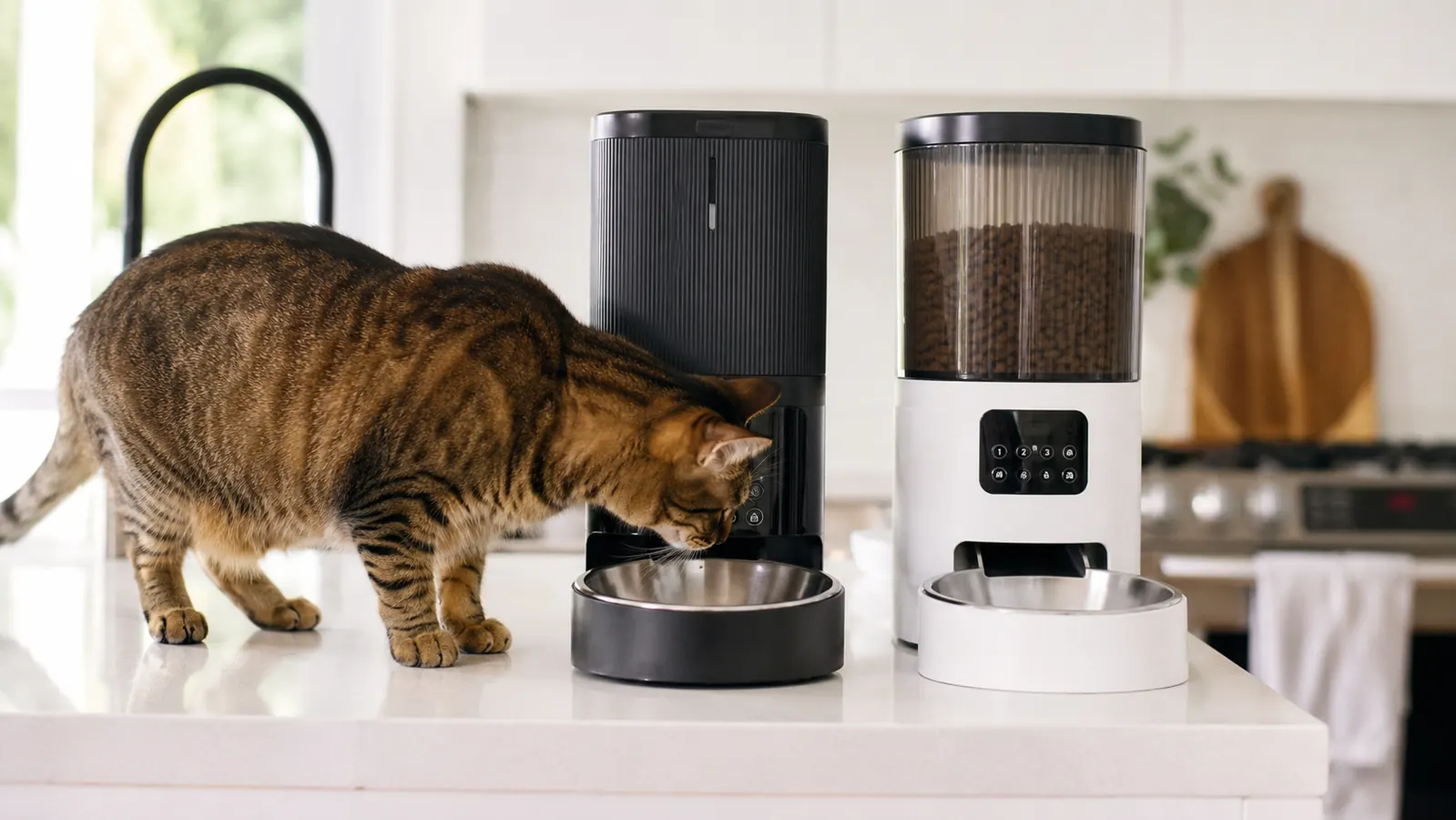
Here is the short answer: if your biggest worry is the feeder jamming at 6am while you are still in bed, the PETLIBRO is the one I would put my money on. I ran both feeders in my house over several weeks, swapping them between my two cats, Biscuit and Fig. The WOPET is not a bad feeder. But the PETLIBRO is a more consistent feeder, and consistency is the whole point.
Both the PETLIBRO 5L WiFi Feeder and the WOPET automatic feeder sit in the same price neighborhood and both promise 5G WiFi control, programmable meal schedules, and a sealed design that keeps kibble fresh. On paper they look almost identical. In practice, there are real differences that matter if you are counting on these feeders to work every single morning, including the mornings you are traveling and can not walk over to fix a jam.
| Feature | PETLIBRO 5L WiFi Feeder | WOPET Automatic Feeder |
|---|---|---|
| Hopper Capacity | 5L (approx. 20 cups dry kibble) | 6L (approx. 24 cups dry kibble) |
| WiFi Connectivity | 2.4GHz and 5GHz dual-band | 2.4GHz only |
| App Platform | PETLIBRO iOS + Android (dedicated) | Tuya Smart (third-party platform) |
| Meals Per Day | Up to 6 programmable meals | Up to 6 programmable meals |
| Portion Size Range | 1 to 10 portions per meal (approx. 5ml each) | 1 to 12 portions per meal (approx. 5ml each) |
| Freshness Seal | Twist-lock lid with desiccant compartment | Standard snap lid, no desiccant |
| Power Options | AC adapter plus 3x D batteries backup | AC adapter only (no battery backup) |
| Voice Recording | 10-second personalized meal chime | 10-second voice recording supported |
| Amazon Rating | 4.2 stars / 9,657 reviews | Approx. 4.0 stars (fewer reviews) |
Where PETLIBRO Wins
The dual-band WiFi support is a genuinely useful feature that most buyers overlook until they run into problems. My kitchen sits on the far side of the house from the router, and 2.4GHz-only devices go offline on me regularly. The PETLIBRO's 5GHz support gave it a stable, fast connection right away. Over several weeks of daily use I had zero missed feedings due to app connectivity. That matters a lot when you are away for a weekend and watching the feeding log from a hotel room.
The battery backup is the other thing that sold me. The PETLIBRO takes three D batteries that kick in automatically if the power goes out. I found this out by accident during a brief outage one morning. The feeder dispensed Biscuit's breakfast right on schedule, and I only noticed because I checked the app later. The WOPET has no backup power option at all. One outage and your cats miss a meal. For most people that is a minor inconvenience. For someone managing a diabetic pet or a cat on a strict feeding schedule for weight management, it is not minor at all.
PETLIBRO also uses a dedicated first-party app rather than routing everything through Tuya Smart, which is a generic home automation platform shared by hundreds of unrelated devices. The PETLIBRO app is built specifically for their feeders and it shows: the scheduling interface is cleaner, portion history is easier to read, and I never got a generic Tuya error message. The app works. That sounds like a low bar but it is the bar that matters most when you are setting feeding times at 11pm before a work trip.
Where WOPET Wins
The WOPET has a 6-liter hopper versus the PETLIBRO's 5-liter, which is a real advantage if you have a large dog or multiple pets and you want to go longer between refills. For big-breed owners who fill on Sunday and want to forget about it all week, that extra liter adds up. The WOPET also tends to run slightly cheaper when both are in stock, which matters if budget is the deciding factor.
The WOPET's portion range goes up to 12 portions per meal versus PETLIBRO's 10, which gives slightly finer control at the high end if you have a bigger pet who needs larger meals. For cats and small dogs the difference is academic. For a 60-pound dog eating twice a day, that extra headroom might be relevant. If your only goal is maximum kibble capacity at the lowest price and you are not worried about power outages or WiFi dead zones, the WOPET checks those boxes.
Your pet's breakfast should not depend on your WiFi being perfect
The PETLIBRO 5G WiFi Feeder holds 5 liters, runs on backup batteries during outages, and connects on both 2.4GHz and 5GHz networks. Over 9,600 buyers on Amazon. Check today's price below.
Amazon Check Today's Price on Amazon →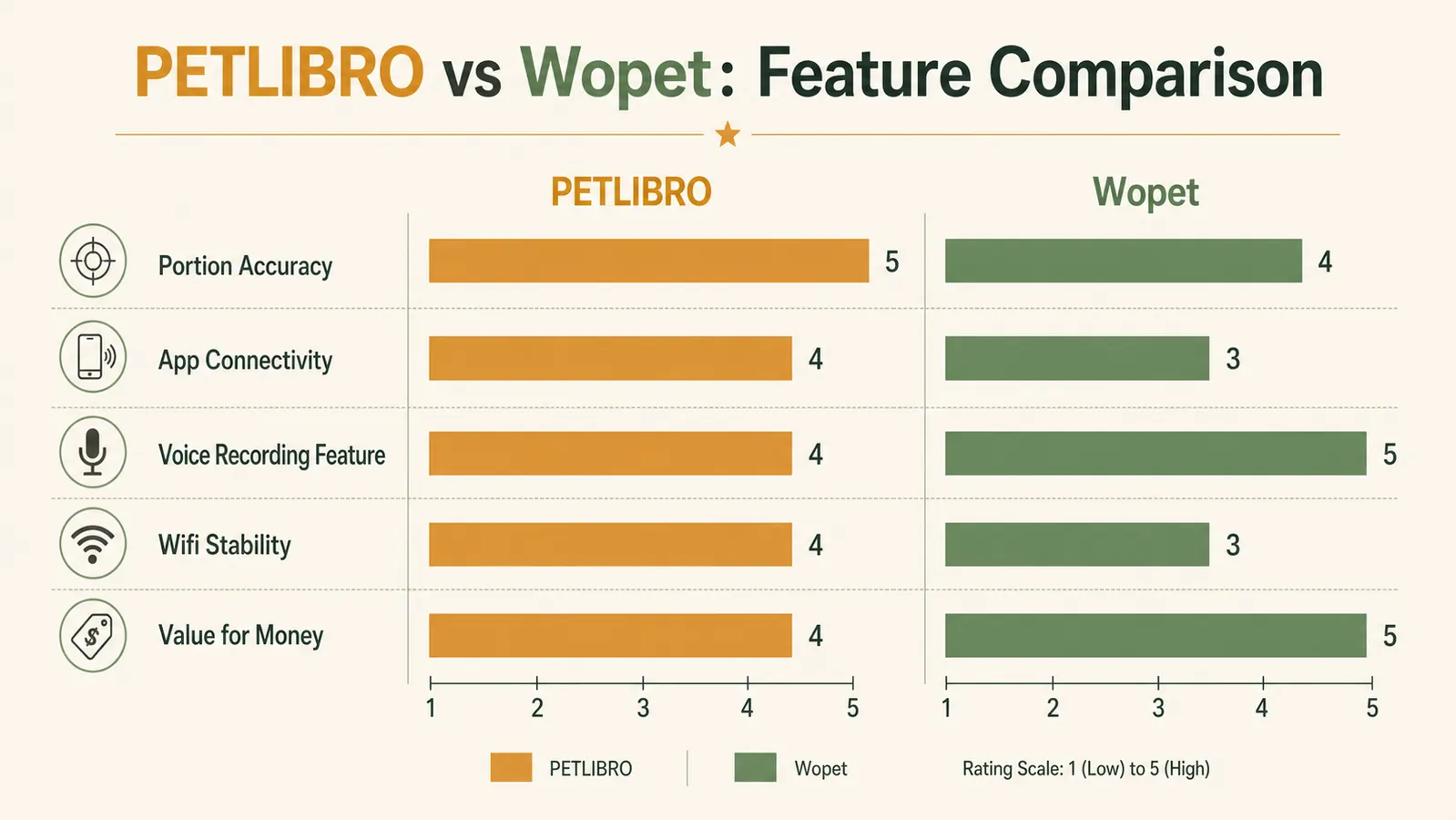
App Quality: The Difference That Trips People Up
Most people buying an automatic feeder for the first time focus on capacity and price. The app is an afterthought. Then they get home, try to set a schedule at 10pm, and spend 45 minutes fighting a clunky interface. I have been there. With the PETLIBRO app, setup took about eight minutes: connected to WiFi, set four daily meals, recorded a voice chime so Biscuit would come running. Done. I checked the app the next morning from my bedroom and the feeding had logged correctly.
With the WOPET, setup was longer because the Tuya platform asks you to configure the device through a generic device-pairing flow that is not specific to feeders. Once it is set up it works, but the initial friction is real. If you are not particularly tech-comfortable, that extra complexity is a deterrent. There were also a couple of reviews I noticed mentioning that Tuya app updates sometimes break device pairing, which is the kind of problem you do not want to discover on a Monday morning when you are already late.
Consistency is the whole point of an automatic feeder. The one that keeps your pet on schedule every single morning, including the ones where you are not home, is the one worth buying.
Freshness and Kibble Jam Rate
The PETLIBRO has a twist-lock lid with a built-in desiccant compartment. In humid climates or during summer months, kibble left in an open hopper can get slightly soft and start to clump, and clumped kibble is the main cause of auger jams. The desiccant compartment was not something I thought I needed until the third week of summer when I noticed the WOPET was dispensing slightly sticky kibble clusters. The PETLIBRO's hopper stayed drier throughout.
Neither feeder is jam-proof. Both can struggle with very small kibble that slides sideways, or with very large kibble that does not fit the auger groove cleanly. I use a standard medium-sized dry kibble for both cats and had no jams with the PETLIBRO over the full test period. The WOPET jammed once, on a hot and humid afternoon. A quick tap freed it and it ran fine afterward. Not a dealbreaker, but worth knowing if you live somewhere with high humidity in summer.
Who Should Buy Which
Buy the PETLIBRO if: you have cats or small dogs, you want a feeder you can manage from your phone without tech frustration, you live somewhere with occasional power outages, or your WiFi signal in the kitchen is not rock-solid. The dual-band support, battery backup, and clean dedicated app make it the more dependable day-to-day feeder for most households. It has more reviews on Amazon and a slightly higher rating than the WOPET, which reflects real-world use over time. If you want the full deep dive on what five months of daily use actually looks like, read the long-term review linked at the bottom of this page.
Buy the WOPET if: you have a larger dog who needs maximum hopper capacity, you are already comfortable with the Tuya Smart platform from other smart home devices, and budget is genuinely the deciding factor. It is a functional feeder. It will feed your pet on schedule most days. Just know going in that you are trading the battery backup and dedicated app for a slightly larger hopper and a slightly lower price. For a healthy adult dog in a stable home with reliable power and strong WiFi, that trade might be perfectly fine.
Five months in, two cats fed, zero missed meals
The PETLIBRO 5L WiFi Automatic Feeder is what I would recommend to any pet parent who wants a set-it-and-trust-it feeding routine. Up to 6 meals a day, battery backup, dual-band WiFi, voice recording. See current pricing and availability on Amazon.
Amazon Check Today's Price on Amazon →