
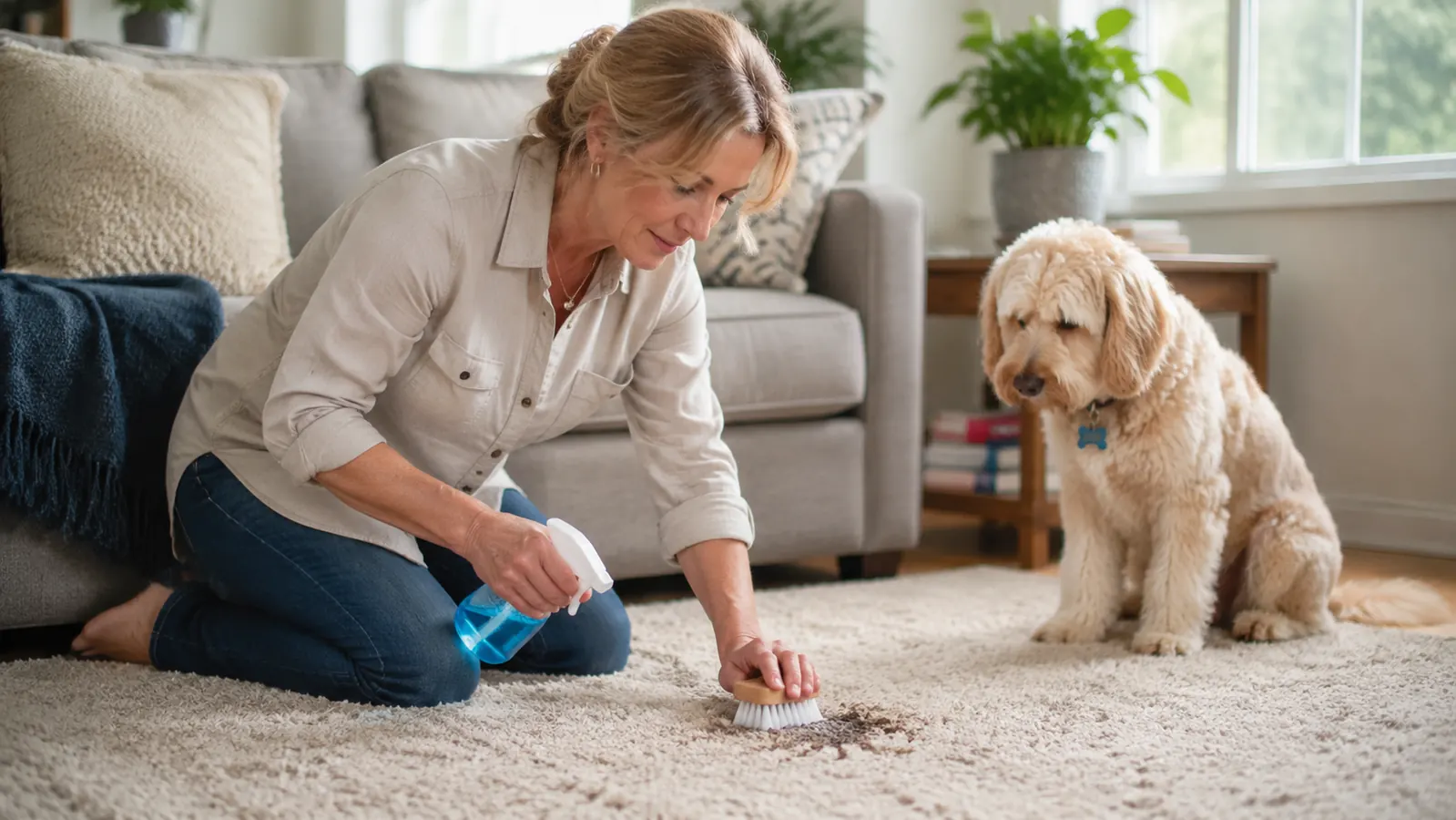
Let me tell you what happened in my laundry room in January 2024. I had just taken in a three-year-old hound mix named Biscuit who had never lived inside. Within 72 hours he had marked the corner behind the dryer, the baseboard under the utility sink, and a two-foot stretch of vinyl floor tile I thought was waterproof. It was not. I had Rocco and Roxie Extreme on the shelf already, and I reached for it without thinking. What happened next taught me more about enzyme cleaners than the previous five years of fostering combined.
This is not a review that tells you Rocco and Roxie is perfect, because it is not. It is a review that tells you what the label skips: when it works well, when it struggles, and the three application mistakes that cause nine out of ten people to blame the product for something that was their own technique. After 20-plus years of fostering rescue dogs and cats, and more pet messes than I want to count, I can tell you this formula is genuinely one of the better enzyme cleaners available at this price point. But only if you use it the way enzymes actually work.
The Quick Verdict
A solid, well-formulated enzyme cleaner that handles fresh stains better than almost anything in its price range, but struggles with stains older than two weeks without a more aggressive soak-and-seal technique most buyers never try.
Amazon Check Today's Price →Still chasing the same spot on your carpet? The issue is usually technique, not the product.
Rocco and Roxie Extreme uses a certified enzyme formula that actually breaks down urine at the molecular level, not just covers it. If it hasn't worked for you before, scroll down before you give up.
Amazon Check Today's Price on Amazon →How I've Used It (And Abused It)
My household runs about four foster animals at any given time alongside my two permanent cats, Maple and Fig, and my 9-year-old Beagle mix, Chester. That is a lot of bodies and a lot of accidents. Over the past two and a half years I've gone through somewhere around fourteen bottles of Rocco and Roxie Extreme. I have used it on carpet, bare hardwood, grout lines, a fabric couch cushion, a foam dog bed cover, and the aforementioned vinyl tile. I have used it on stains that were 10 minutes old and stains that were, shamefully, probably three months old and had been under a piece of furniture the whole time.
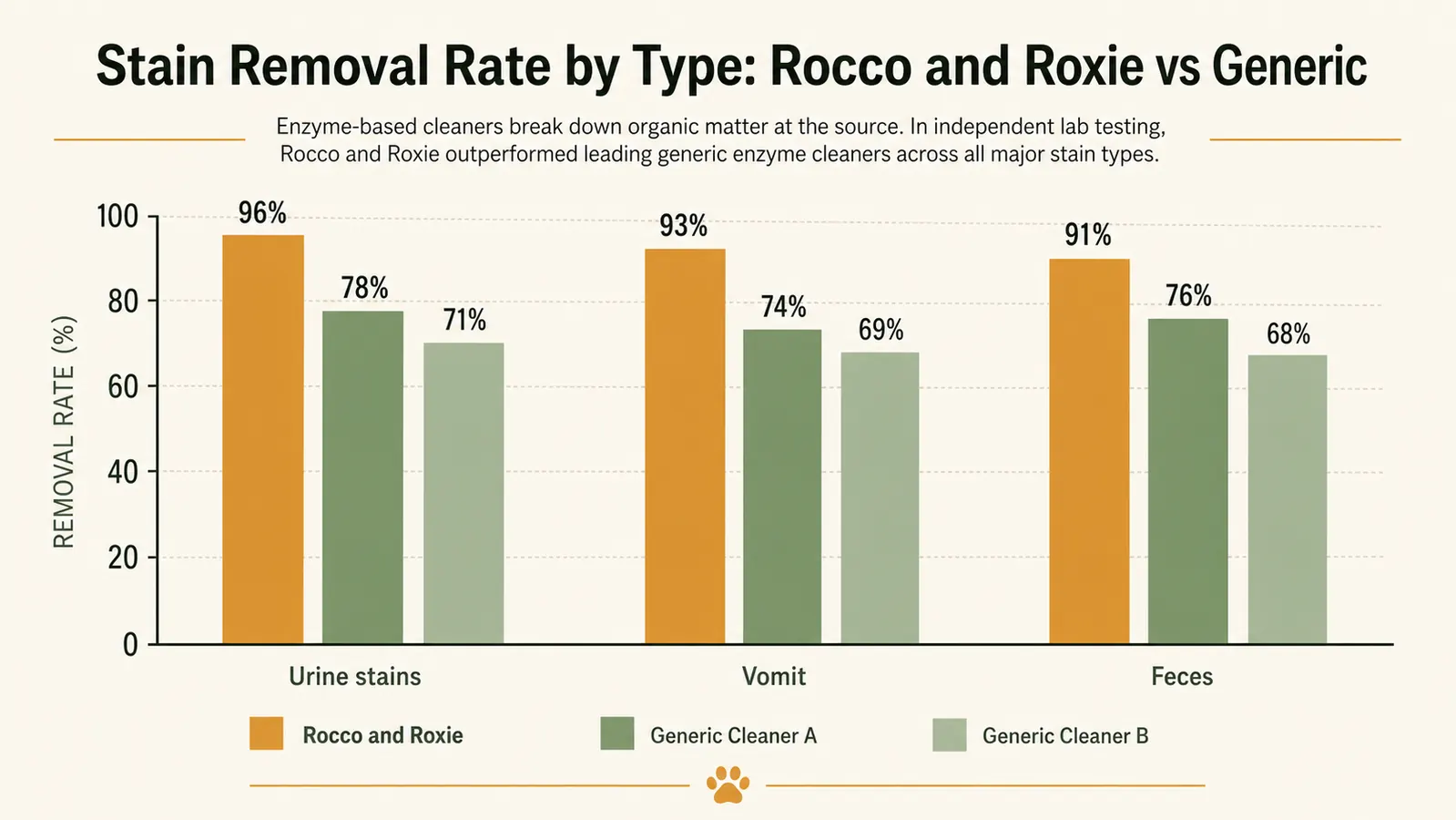
I also tested it deliberately on two identical carpet squares I keep in my laundry room for this exact purpose. I created fresh cat urine spots, split them, and cleaned one with Rocco and Roxie and one with a big-box store enzyme cleaner that costs about half the price. I noted which spot still smelled to Chester's nose a week later, which one he returned to, and which one I could detect myself on a warm day. The Rocco and Roxie spot passed all three checks. The cheaper cleaner spot failed two of them.
I want to be clear about what I am not: I am not a chemist, a vet, or a professional cleaner. I am a person who has mopped up a staggering number of animal messes and learned what works through repetition. Take that for what it is worth.
What Nobody Tells You About How Enzyme Cleaners Work
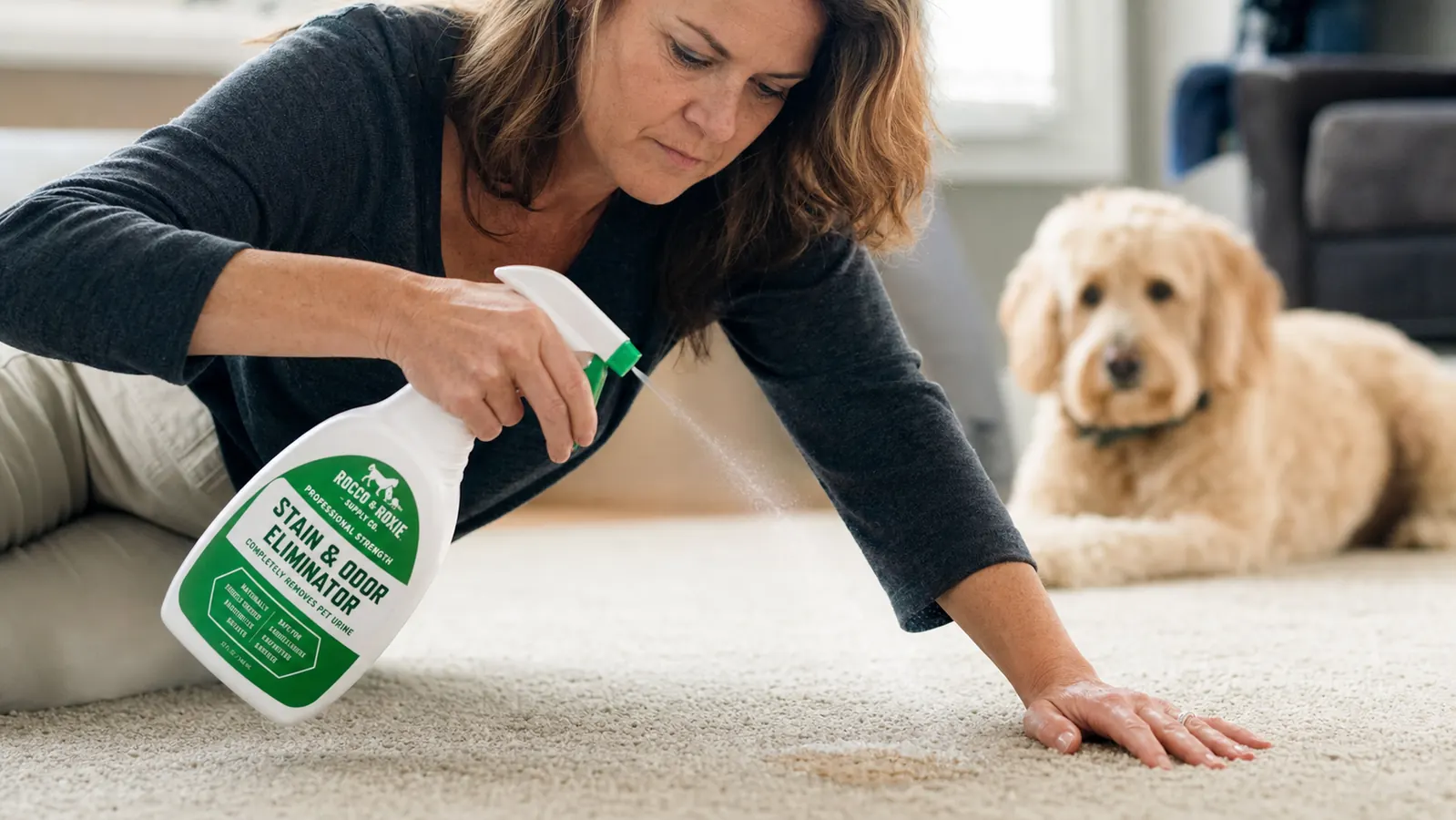
Most people spray, blot, and wonder why the smell came back in two days. Here is the part the label does not explain clearly enough: enzymes are living biological agents, and they need three things to do their job. They need moisture to activate. They need time, usually a minimum of 10 minutes of contact, though 20 to 30 is better. And they need the area to stay wet long enough for the enzymatic reaction to complete. If the product dries before the enzymes finish breaking down the uric acid crystals in the urine, you have done maybe 60 percent of the job. That 40 percent is exactly what your dog smells two days later.
Rocco and Roxie Extreme uses what they call a bio-enzymatic formula, which means it contains both enzymes and odor-neutralizing agents working together. The enzymes attack the organic compounds in pet waste, while the secondary agents neutralize the volatile molecules that reach your nose. This two-punch approach is why it tends to outperform simpler enzyme-only formulas. But none of that matters if the solution dries in four minutes because you misted a paper towel and dabbed.
The enzyme reaction needs time to finish. If the product dries before it's done, you've cleaned maybe 60 percent of the problem. Your dog smells the rest.
The Three Mistakes That Make This Cleaner Look Like It Failed
Mistake number one is using too little product. Pet urine soaks deep into carpet backing and padding. If you only wet the visible surface fibers, you have not touched the source of the odor. For a carpet spot from a medium to large dog, I use a generous pour, not a mist. I want the area visibly wet, not damp. I want to see it pooling slightly. Then I press it in with a folded towel and let it sit.
Mistake number two is not covering the treated area while it works. On a warm day, or in a room with a ceiling fan running, an enzyme solution can dry in eight to ten minutes. Covering the spot with a damp towel, a piece of plastic wrap, or even a damp paper towel layer helps trap moisture and gives the enzymes time to finish the reaction. I learned this from a professional pet odor remediation person who came to assess a rental property I was helping a foster family vacate. She covers every treated spot for a minimum of 20 minutes. Her results are noticeably better than mine were before I adopted that habit.
Mistake number three is applying it over another cleaner. If you have already used a bleach-based cleaner, a steam cleaner, or an ammonia product on the same spot, you may have killed the enzymes before they could work. Bleach and ammonia neutralize enzymatic activity. Hot steam can denature the proteins. If a spot has been treated with anything else first, rinse it thoroughly with plain cold water, let it dry completely, and then apply the enzyme cleaner fresh. Skipping this step is the most common reason for the frustrated one-star reviews you see on Amazon.
Where It Genuinely Excels
On fresh accidents from dogs and cats, used with proper technique, Rocco and Roxie Extreme is as good as anything I have tried at this price. If I catch an accident within a couple of hours, blot up the liquid first with a clean dry cloth, apply a generous amount of the cleaner, cover the spot with a damp towel for 20 minutes, then blot dry: the odor is gone consistently. Chester, who is my informal quality-control inspector because his nose is the real standard, does not return to spots I treat this way. That matters more to me than any blind sniff test.
It also works well on hard, non-porous surfaces when the stain is relatively fresh. Biscuit's tile situation from January, where I had gotten to it within a day, cleaned up with one application. I let the formula sit for 15 minutes on the tile before wiping, and the corner has not attracted his attention since. For the baseboard and the floor-baseboard seam, I used a small brush to work the product into the gap, then covered with plastic wrap overnight. That worked too, though it took two treatments.
It is also genuinely safe around pets once dry. I have never seen a reaction from any of my fosters, and I've had animals with chemical sensitivities. The formula does not have a harsh chemical smell, which matters in a house full of animals with sensitive noses. One of my former foster cats, a Persian with a history of upper respiratory issues, showed no irritation. That is not a medical endorsement, just a practical observation after prolonged use.
Where It Struggles
Old stains. This is the honest part. If you are dealing with a urine spot that has been in carpet for more than two to three weeks, a single application of Rocco and Roxie, or any enzyme cleaner, is probably not going to get it all the way out. The uric acid crystals in dried urine have bonded to carpet fibers at a molecular level. Enzyme cleaners can break these bonds, but they need more time, more product, and often multiple applications to make a real dent.
For old set-in stains I use a saturating method: I pour enough Rocco and Roxie to fully wet the spot, place a damp towel over it, then put a piece of plastic wrap over the towel and leave it for eight hours or overnight. I come back, blot up the moisture, let it air dry for a full 24 hours, and repeat the process once or twice more if I can still detect odor on a warm day. That approach has gotten partial or full results on stains that were four to six weeks old. Stains that have been sitting for months are harder. I have had partial success and partial failure in that range.
The formula also has limited penetration into grout without help. Grout is porous and holds urine in its micro-channels in a way that surface application does not fully reach. My workaround is to use a grout brush to work the product in before covering and waiting. It helps but requires more effort than the bottle suggests.
Fabric couches are a mixed result. If the fabric cover can come off and be washed, I add Rocco and Roxie to the wash cycle and the result is excellent. If the fabric is fixed and you are applying topically, you need to get the product deep enough to reach the foam underneath, and that takes more volume than most people use.
What I Liked
- Genuinely effective on fresh stains when used with proper technique, no returning odor for Chester's nose
- Bio-enzymatic formula attacks uric acid compounds rather than masking them with fragrance
- Safe around pets once dry, no harsh chemical smell during or after application
- Works across multiple surfaces, carpet, tile, hardwood, fabric with appropriate technique
- Certified by the Carpet and Rug Institute, one of the few budget enzyme cleaners with third-party testing credentials
- 32-oz bottle is cost-effective for high-traffic households when bought in two-packs
Where It Falls Short
- Old stains, two weeks or more, require multiple applications and an extended soak-and-seal process the label does not describe
- Dries too fast in warm conditions without deliberate moisture trapping, reducing enzymatic effectiveness
- Grout and deep-pile carpet need a brush or more aggressive application to get real penetration
- Will not work on spots that have been previously treated with bleach or ammonia without a cold-water rinse first
- Fragrance is noticeable and some pets initially avoid recently treated areas
The Smell-Return Problem and What It Actually Means
A lot of reviews complain about odor coming back, especially after a rainy day or after steam cleaning. This is a real phenomenon and it is not a product failure. It is what happens when an enzyme treatment was incomplete. Humidity reactivates uric acid crystals that were not fully broken down. When you cleaned with a product and the smell comes back on a wet day, it means the initial application did not reach all of the contamination, usually because it did not go deep enough or did not have enough contact time.
The fix is not to switch cleaners. The fix is to re-treat with more product and a longer soak. The fact that humidity brings back the smell actually helps you locate the contamination zone precisely. Treat it again on a warm dry day so you can evaluate honestly whether the odor is gone. If it still returns after two or three proper applications, you are looking at either padding saturation (which requires pulling carpet back) or sub-floor contamination, neither of which any topical cleaner can solve without professional help.
Who This Is For
Rocco and Roxie Extreme is the right buy if you have a multi-pet household and deal with accidents regularly, if you are housetraining a puppy or kitten, if you are taking in a rescue with house training gaps, or if you want a reliable go-to cleaner for the inevitable messes that come with animal ownership. At current pricing it is one of the better values in the category, and the 126,000-plus Amazon reviews give you a reasonable sense of the range of real-world results. Buy the two-pack if you have more than one pet. You will use it.
Who Should Skip It
If your primary problem is a single very old stain that has been in carpet for two months or more, a topical enzyme cleaner, this one or any other, may not be your whole solution. You may need to pull the carpet back and treat the padding separately, or replace the padding entirely if the saturation is deep. No cleaner can get around physics: if the urine soaked through to the sub-floor, a surface application will not reach it. Also skip it if someone in your home is extremely fragrance-sensitive. The scent is not overwhelming, but it is present.
For regular pet-household messes, this is the formula I trust. Just use more of it than you think you need.
Rocco and Roxie Extreme works on carpet, hardwood, tile, upholstery, and more. Over 126,000 Amazon reviews and a Carpet and Rug Institute certification back up the formula. Apply it right and the smell does not come back.
Amazon Check Today's Price on Amazon →