

If your dog is slowing down on stairs, hesitating before jumping onto the couch, or stiff after a nap, you have probably already started comparing joint supplements. Two of the most common names that come up are Cosequin and VetIQ Hip and Joint chews. I have been fostering and rescuing senior dogs for over 20 years, and last winter I ran both products at the same time on two of my fosters, Biscuit (a 12-year-old Beagle mix, 24 lbs) and Earl (a 10-year-old Shepherd mix, 62 lbs). Same eight-week window. Same exercise routine. Same diet. Different supplements. Here is what I found.
Short answer: Cosequin is the better product for most senior dogs, and it is the one I keep stocked in my cabinet. VetIQ is cheaper and widely available, but the ingredient profile is meaningfully thinner, and I did not see the same results. If you are choosing between these two and your dog is over eight years old or showing visible signs of stiffness, I would not reach for the budget option.
| Cosequin DS Plus MSM | VetIQ Hip and Joint Chews | |
|---|---|---|
| Glucosamine per chew | 500 mg | 250 mg |
| Chondroitin per chew | 400 mg | Not included |
| MSM per chew | 250 mg | 50 mg |
| NASC quality seal | Yes | No |
| Count per bag | 60 chews | 90 chews |
| Palatability (my dogs) | Ate willingly, no fuss | Ate willingly, no fuss |
| Approximate cost per day | Lower per therapeutic dose | Lower sticker price, higher per equivalent dose |
| Veterinary clinical studies | Yes, published studies | None listed |
| Amazon rating (reviews) | 4.7 stars (78,000+ reviews) | 4.4 stars (fewer reviews) |
Where Cosequin Wins
The biggest difference between these two supplements is not the price tag. It is the chondroitin. Cosequin includes 400 mg of chondroitin sulfate per chew alongside its 500 mg of glucosamine. VetIQ does not include chondroitin at all. Glucosamine and chondroitin work together in cartilage maintenance, and the research backing the combination is substantially more robust than glucosamine alone. If you are giving a supplement specifically to support aging joints, leaving out chondroitin is a real gap.
Cosequin also carries the NASC (National Animal Supplement Council) quality seal, which means the manufacturing facility has been audited for quality controls, label accuracy, and adverse event reporting. That matters to me. After 20 years of fostering, I have seen products that were labeled accurately and products that were not. A third-party audit is not a guarantee, but it is a meaningful signal. With VetIQ, I could not find equivalent third-party quality verification.
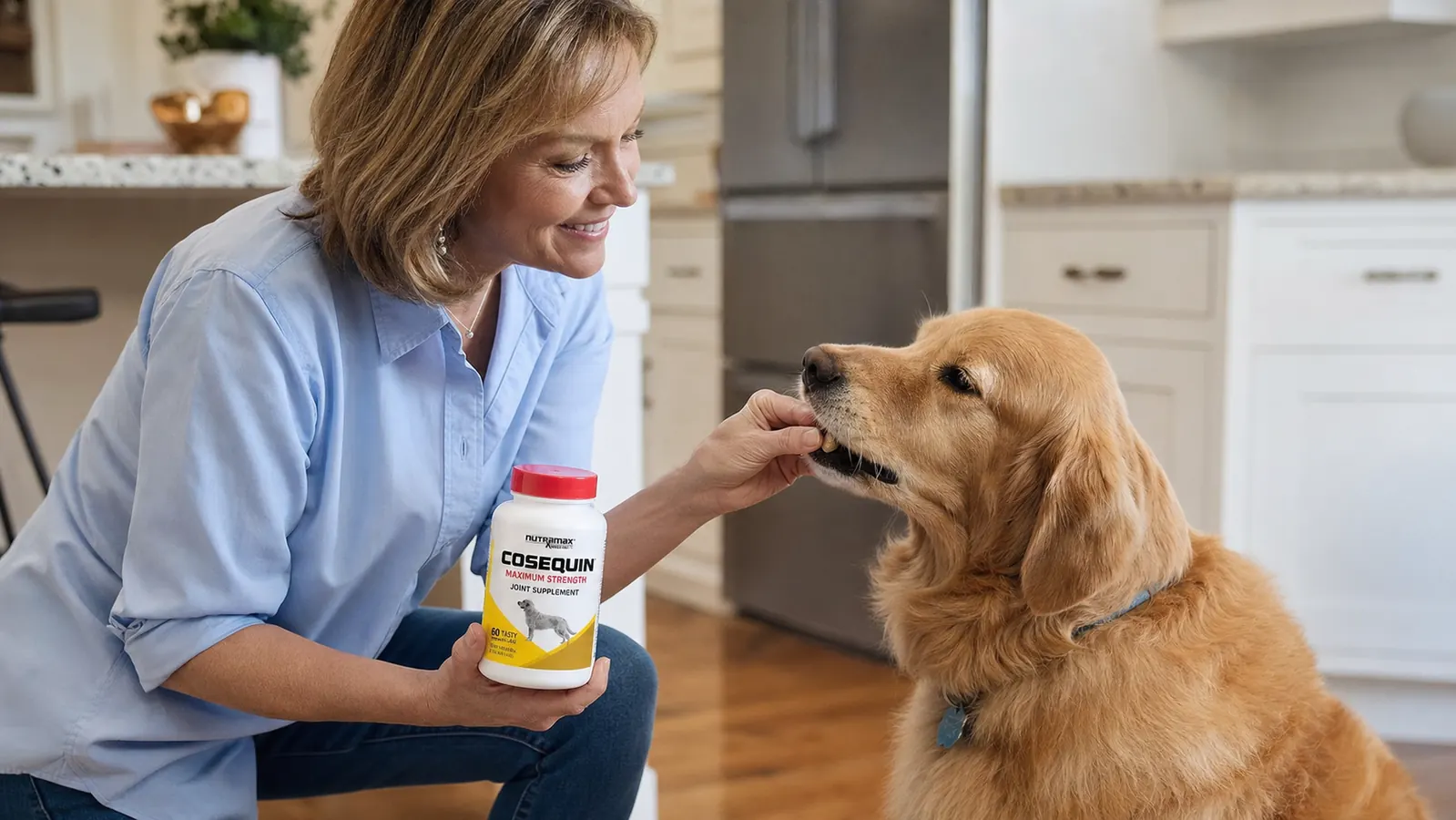
On Biscuit, my 12-year-old Beagle, the results were visible by week five on Cosequin. She started taking the stairs more willingly, and the morning-stiffness window, those first ten minutes after she gets up from sleeping, got noticeably shorter. By week eight she was trotting a full lap of the backyard before settling. That kind of slow, steady improvement is exactly what a quality glucosamine-chondroitin-MSM combination is supposed to do, and it matched what I have seen with Cosequin over the years on other senior fosters.
Where VetIQ Wins
VetIQ does two things better than Cosequin. The first is price. At the shelf level, a bag of VetIQ chews is cheaper than a comparable count of Cosequin, and if you have a large dog or multiple dogs, that difference adds up across a month. The second is availability. VetIQ chews are stocked in more physical stores, including many dollar-store adjacent pet sections, which matters if you are in a rural area and your online order is running late.
On Earl, my 62-pound Shepherd mix, VetIQ did show some effect by weeks six and seven. He is a stoic dog and not dramatic about pain, so I track his indicators carefully: how fast he drops into a down, whether he hesitates at the car step, and how much he pushes through a walk versus hanging back. On VetIQ he improved modestly on two of those three markers. Meaningful? Maybe. As dramatic as what I see with Cosequin on a dog his size? No. But if cost is a genuine barrier to supplementing at all, VetIQ is still better than nothing.
Your dog's joints are not getting younger. Cosequin is the supplement most vets have on their own shelf.
Over 78,000 Amazon reviews. NASC-audited quality. The glucosamine-chondroitin-MSM formula backed by published clinical studies. Check today's price and see if it is right for your dog.
Amazon Check Today's Price on Amazon →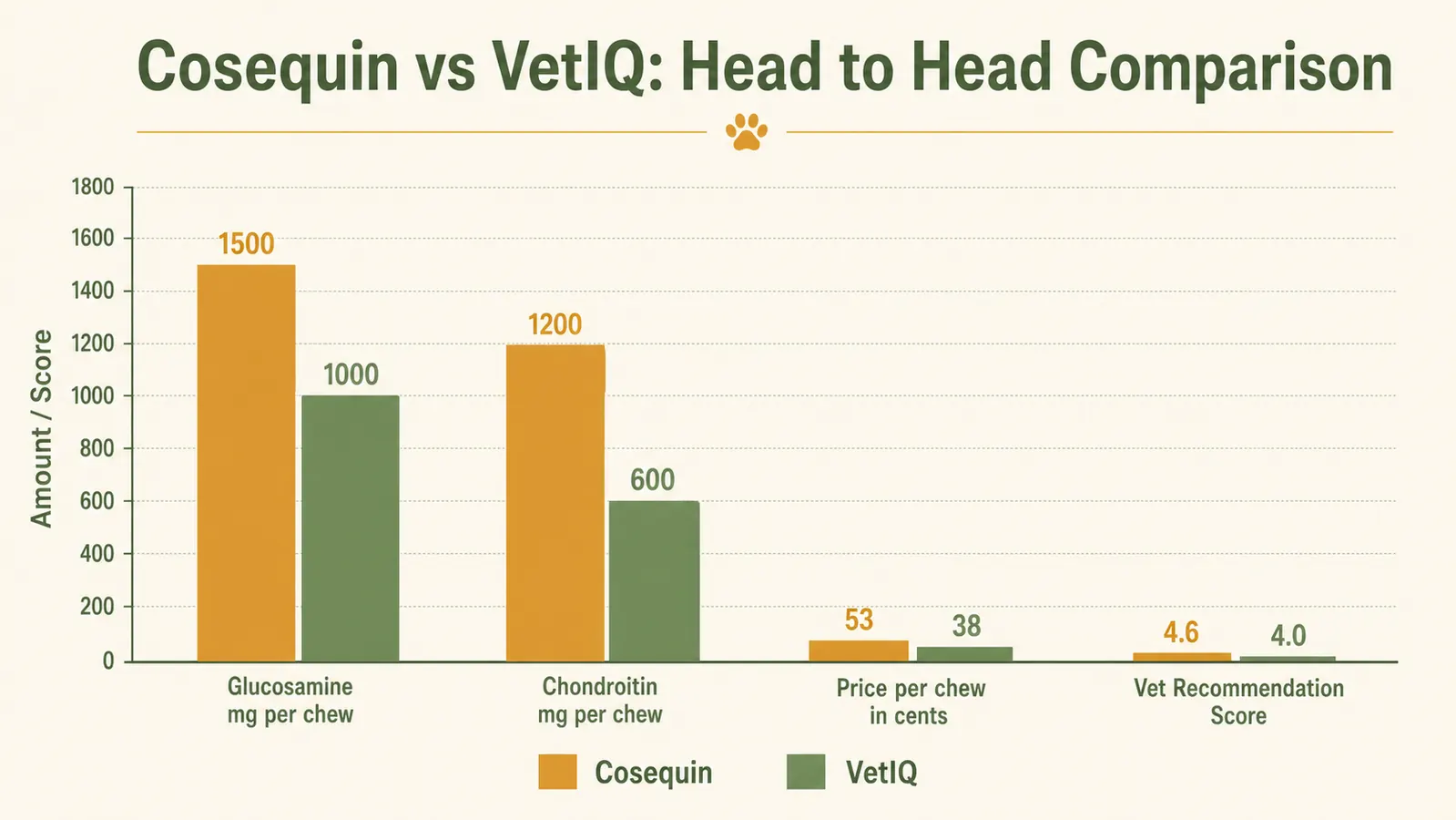
Ingredient Deep Dive: Why the Formulas Are Not Equal
Let me be specific, because supplement labels can look similar until you actually compare them. Cosequin DS Plus MSM delivers 500 mg of glucosamine hydrochloride, 400 mg of sodium chondroitin sulfate, and 250 mg of MSM per chew. VetIQ Strength Hip and Joint chews list 250 mg of glucosamine hydrochloride and 50 mg of MSM. No chondroitin. So you are getting half the glucosamine, no chondroitin, and a fifth of the MSM compared to Cosequin.
MSM (methylsulfonylmethane) is worth paying attention to specifically. It contributes sulfur, which is a building block for cartilage, and it also has anti-inflammatory properties that glucosamine alone does not. At 250 mg per chew, Cosequin delivers a dose that shows up in the research. At 50 mg, VetIQ is more of a token inclusion on the label than a functional therapeutic dose. I am not saying VetIQ has no effect. I am saying the formulas are not comparable, and the price difference does not fully reflect that.
The price gap between Cosequin and VetIQ is real. But so is the ingredient gap. When I am dealing with a dog in visible discomfort, I want the formula that has the clinical backing behind it.
Palatability and Daily Use
Both products passed the real test in my house, which is: will the dog actually eat it without a game of hide-the-chew in a meatball? Both Biscuit and Earl took both supplements willingly right off my palm. Cosequin has a mild chicken-ish flavor that most dogs seem to like without being so intense that it causes soft stool, which I have seen with some highly flavored supplements. VetIQ chews have a slightly sweeter smell, almost molasses-adjacent, and both my fosters ate them without complaint. Palatability is a tie.
One practical note on Cosequin: there is a loading dose recommendation for the first four to six weeks, usually two chews a day, before dropping to a maintenance dose of one chew. That doubles the cost during the loading phase, but it also means you are getting therapeutic levels into the dog faster. VetIQ does not have a formal loading protocol. Neither approach is wrong, but the loading phase is worth factoring into your first-month budget if you go with Cosequin.

What the Amazon Review Volume Tells You
Cosequin sits at 4.7 stars with over 78,000 reviews on Amazon. That is not a paid review pile. A product accumulates a review count like that because a large number of actual buyers found it worth writing about. VetIQ has a respectable rating too, but at a significantly lower review count. When I am buying something for a foster whose joint health I am responsible for, I weight review volume heavily. It is imperfect market research, but 78,000 data points are harder to dismiss than a few hundred.
I also pay attention to the pattern inside the negative reviews. Cosequin's one-star reviews are almost entirely about shipping, wrong item sent, or dogs that refused to eat it (a minority, in my experience). The one-star reviews that say 'saw no difference' are a small fraction. VetIQ's negative pattern shows more 'no visible improvement' comments relative to the overall count, which matches my own eight-week experience with Earl.
Who Should Buy Which
Buy Cosequin if your dog is showing visible joint symptoms, is over eight years old, or is a large breed that is known to be joint-prone (Labs, German Shepherds, Golden Retrievers, Rottweilers). Also buy Cosequin if you want the supplement with the strongest published clinical backing and the most consistent long-term user evidence. The formula works, and the track record shows it. For my long-term fosters and any dog I personally adopt, it is my first choice. You can read more about my full six-month experience with it in my Cosequin long-term review.
Consider VetIQ if you genuinely cannot afford Cosequin right now and your only alternative is no supplementation at all. Something is better than nothing, and VetIQ does include glucosamine. It is also reasonable as a preventive supplement for a younger dog who is not yet symptomatic, where you are not trying to reverse existing cartilage loss but simply maintain what is there. Just know what you are getting: a lighter formula at a lower dose per chew.
A note I always include whenever I write about joint supplements: these are not a substitute for a vet evaluation. If your dog is in significant pain, suddenly limping, or has been diagnosed with a specific orthopedic condition like hip dysplasia or cruciate damage, please get your vet involved before choosing a supplement protocol. These products support joint health in generally healthy aging dogs. They are not treatment for diagnosed injury. You can also read my full guide to easing senior dog joint stiffness at home for the full picture beyond supplementation.
Ready to try the one with 78,000 reviews behind it? Cosequin has been my go-to for senior fosters for years.
Nutramax Cosequin DS Plus MSM delivers 500 mg glucosamine, 400 mg chondroitin, and 250 mg MSM per chew. NASC-audited quality. Check today's price on Amazon and see which size fits your dog.
Amazon Check Today's Price on Amazon →