
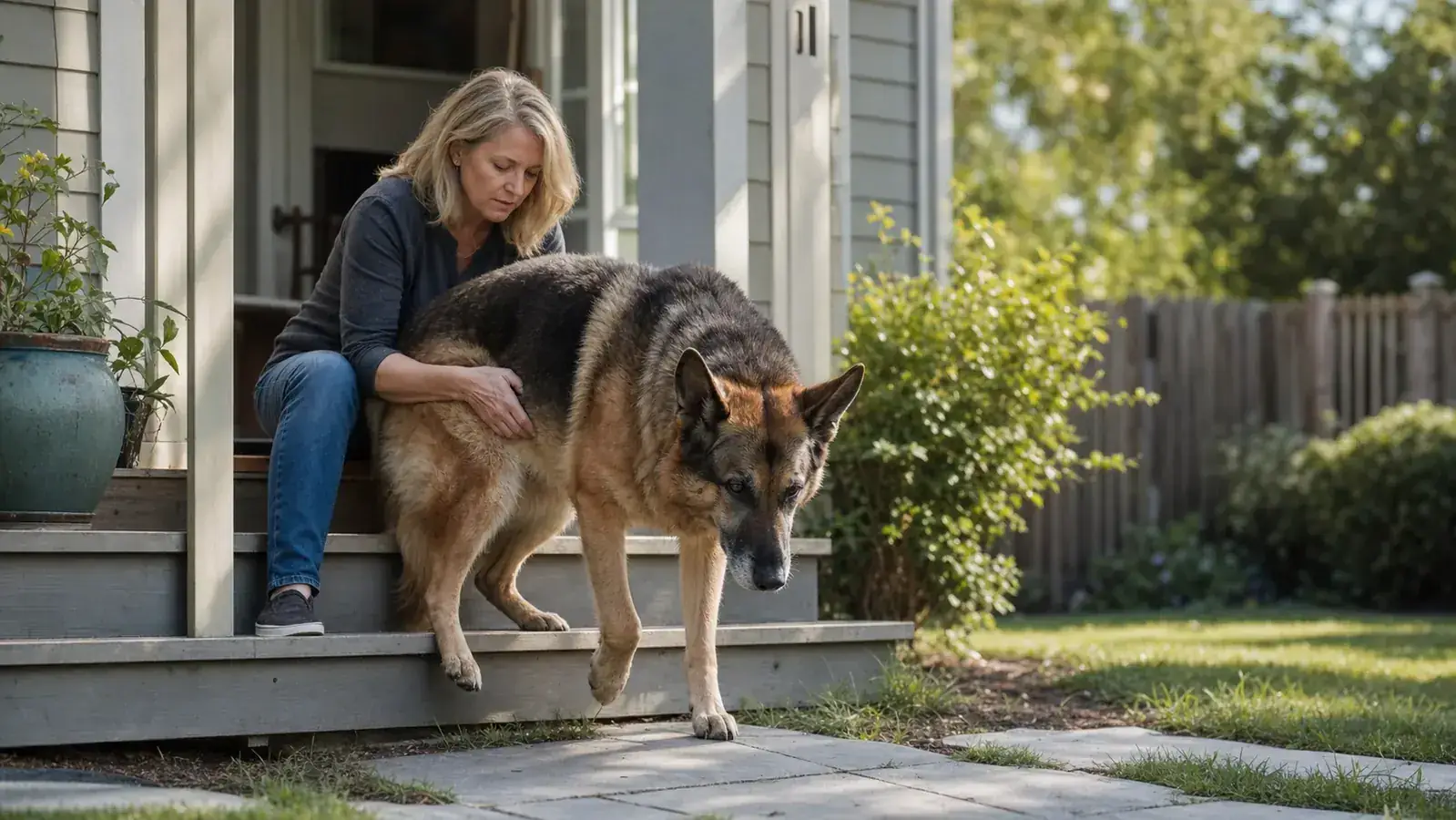
My Lab, Biscuit, turned 13 last spring. She spent most of her mornings staring at me from her bed like she was waiting for the pain to pass before she stood up. That shuffling, three-legged-looking rise every morning is one of the hardest things to watch when you love a dog the way I love her. I've been fostering and rescuing dogs for over 20 years, and joint stiffness is the number one quality-of-life issue I see in dogs over 8. The good news is there is quite a bit you can do at home, without a vet visit for every step, to make a real difference.
This guide covers the five steps I use with every senior dog in my care. Some of them cost nothing. One of them, the joint supplement step, costs about a dollar a day and has made the biggest visible difference for Biscuit and a handful of other older fosters I've run through this routine. I'll tell you what I use and why, but as always, if your dog's stiffness is sudden or severe, that is a conversation for your vet.
The supplement I use in Step 5 has nearly 79,000 reviews and is the most recommended glucosamine product at most vet offices.
Nutramax Cosequin is what I give Biscuit every morning. It is sprinkled right on her food, she eats it without a fight, and it has made a visible difference in how she gets up. Check today's price before you keep reading.
Amazon Check Today's Price on Amazon →Step 1: Adjust Her Exercise to Low-Impact, Short, and Frequent
The worst thing you can do for a stiff senior dog is nothing. Complete rest allows muscles to atrophy, which puts even more stress on already struggling joints. But a long, hard walk is equally damaging. What actually helps is short, slow, flat-surface movement several times a day. I aim for three 10-to-15-minute walks on pavement or grass, never gravel or stairs if I can avoid it.
For Biscuit, I started this in October when her morning stiffness got noticeably worse. Within two weeks of switching from one 40-minute walk to three shorter ones, she was warming up faster. The first five minutes of any walk she is still a little stiff, but by minute seven she is trotting. That warm-up period is normal for arthritic joints, the same way your own knees feel after sitting too long. The goal is to move them through the stiffness, not skip the movement entirely.
Swimming is the gold standard for low-impact exercise if you have access to it. Even shallow wading in a calm lake or a kiddie pool in summer will do wonders. The buoyancy takes weight off the joints entirely while still working the muscles. I know that is not practical for everyone in January, so the short-walk approach is the everyday version of the same idea.
Step 2: Warm Up the Sleeping Area Before She Wakes Up
Cold muscles and cold joints stiffen overnight. If your senior dog sleeps in an uncarpeted area, on a hard floor, or near a drafty door, morning stiffness will be worse than it needs to be. The fix is two-part: warmth and cushioning. I moved Biscuit off the tile kitchen floor and onto a thick orthopedic foam bed in the bedroom, and I added a fleece blanket she can burrow under if she wants.
The foam matters more than people realize. Standard pet beds compress under a heavier dog's weight and end up barely better than the floor. An orthopedic foam bed stays supportive all night, which means your dog is not spending eight hours with pressure points digging into already inflamed joints. I have a detailed look at the specific bed I use with Biscuit in my Bedsure orthopedic dog bed review, but the short version is that anything with at least 3 inches of high-density foam is worth it for a senior dog.
In winter, I also keep the house at 68 degrees overnight instead of dropping it to 64 to save on the heating bill. The difference in Biscuit's morning rise is noticeable. Cold air and cold floors are joint stiffness accelerants. It is one of the easiest variables to control.

Step 3: Get the Weight Right First
Every extra pound on a dog's frame is roughly four extra pounds of pressure on their joints with every step, a number I first heard from a vet tech at a rescue I partnered with years ago and have never forgotten. Biscuit came to me at 82 pounds about a year ago. At her frame size she should be 72 to 74. That 8-to-10 pound overage was genuinely making her stiffness worse. Getting her down to 75 pounds took four months of measured meals, fewer treats, and substituting plain green beans for part of her kibble portion.
I am not a vet and I am not going to tell you exactly how much your dog should weigh, because that depends on their breed and build. What I will tell you is to ask your vet at the next visit specifically about body condition score and whether your dog is carrying extra weight. If the answer is yes, that is priority number one before any supplement or treatment. Nothing else you do in this guide will be as impactful as getting a heavy dog to a healthy weight.
Step 4: Look at What Is in the Food Bowl
Processed dog foods, especially lower-quality kibbles with corn or soy as the first ingredient, tend to promote inflammation throughout the body, including in joints. Switching to a food with real animal protein as the first ingredient, with omega-3 fatty acids listed in the ingredients, can make a meaningful difference in chronic joint inflammation over several months. I am not saying you have to buy the most expensive food on the shelf. I am saying that the food your dog has eaten for years might be worth revisiting now that they are older.
Omega-3 fatty acids specifically, found in salmon oil or fish-based kibbles, have real evidence behind them for reducing joint inflammation. I add a pump of wild salmon oil to Biscuit's food most mornings. It costs next to nothing per serving and she thinks it is the greatest thing that has ever happened to her. If your dog is already on a premium food with fish in the first few ingredients, you may already be covered. If they are on a budget kibble, adding a salmon oil supplement is an inexpensive place to start.
One thing to avoid: extra calcium supplementation unless a vet has specifically prescribed it. A lot of well-meaning dog owners add calcium to senior dogs' diets thinking it helps bones and joints. For most adult dogs eating a balanced commercial diet, extra calcium actually creates problems rather than solving them. Feed a balanced food, add omega-3s if the food does not already include them, and leave the calcium to the professionals.
Step 5: Add a Glucosamine and Chondroitin Supplement
This is the step that has made the most visible difference for Biscuit, and for probably half a dozen other senior fosters I have run through this routine over the years. Glucosamine and chondroitin are the building blocks of cartilage. As dogs age, their bodies produce less of both, and the cartilage cushioning their joints thins out. Supplementing does not reverse that process, but it supports what cartilage remains and reduces the inflammation around it.
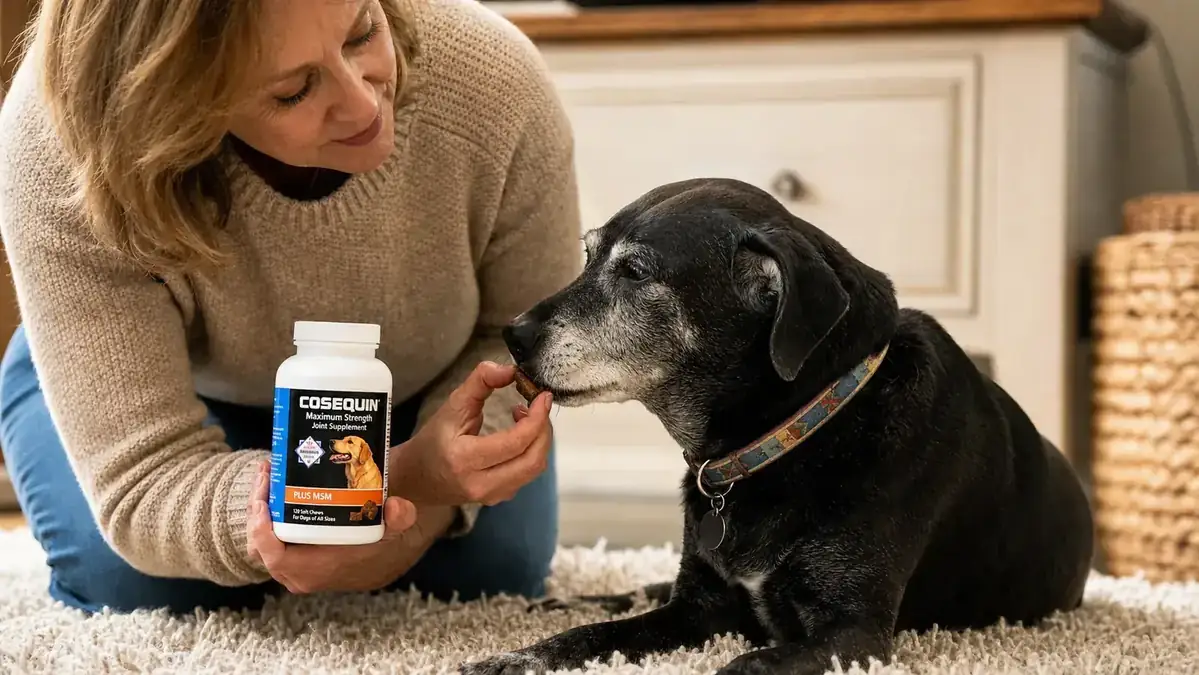
The supplement I use, and have used for years, is Cosequin Maximum Strength with MSM from Nutramax. It is a chewable tablet that Biscuit eats off the top of her kibble without me having to wrestle it into a pill pocket or peanut butter glob. It has glucosamine hydrochloride, sodium chondroitin sulfate, and MSM, the combination most commonly recommended by vets for joint support. Nutramax also has actual clinical research behind their formulations, not just marketing language, which is why I trust it over the dozens of knockoffs on the market.
I started Biscuit on it in late October at the full loading dose (two chews per day for the first four to six weeks) and then dropped to the maintenance dose of one chew per day. By week five, her morning rise had visibly improved. Not cured, she is 13 and has real arthritis, but the shuffling three-legged rise became a slower-but-normal four-footed stand. That is the realistic expectation. You are not going to turn a senior dog into a puppy. You are going to take the edge off the stiffness and add comfort to their days. At nearly 79,000 reviews and a 4.7-star rating on Amazon, Biscuit is far from the only dog whose owner noticed the difference. My full breakdown of how I have used it and what to expect is in my Cosequin long-term review.
What Else Helps
The five steps above will cover the biggest drivers of senior joint stiffness. But a few additional things are worth mentioning for dogs with more significant joint problems. Ramps and steps can be a real help for dogs who sleep on your bed or jump in and out of the car. The act of jumping up or down puts sudden impact on joints that gentle walking does not, and a ramp distributes that load more gradually. I have a small folding ramp I use to get Biscuit into the back of my SUV, and it took about two weeks for her to trust it consistently. Worth the patience.
Massage is another underused tool. Five minutes of slow, gentle circular pressure on the large muscle groups around your dog's hips and shoulders before a walk will increase blood flow and reduce the amount of stiff-legged warm-up time they need. It also gives you a chance to notice any new spots of tenderness or swelling. I do Biscuit's shoulders and hips every morning while she is still on her bed. She has started leaning into it, which is her version of a standing ovation.
Finally, non-slip flooring matters more than most people think. Hardwood and tile floors make arthritic dogs hesitant to move because their feet slide when they try to stand or turn. A few rubber-backed rugs or yoga mats along the routes your dog travels most, kitchen to water bowl, hallway to back door, can make a meaningful difference in how willing they are to get up and move. Willingness to move is the whole game at this stage. Anything that removes friction, figuratively and literally, is a win.
The goal is not to turn a 13-year-old dog into a 3-year-old. The goal is to take the edge off every single day so the good days outnumber the bad ones.
Ready to start Step 5? This is the glucosamine supplement I give Biscuit every single morning.
Cosequin Maximum Strength with MSM by Nutramax. Vet-recommended, research-backed, and one of the most reviewed joint supplements on Amazon. The chewable tablets make it easy to add to any dog's routine without a fight. Check today's price below.
Amazon Check Today's Price on Amazon →